MXene Exfoliation Methods: Understanding the Technologies Behind 2D Material Production
Since their discovery, MXenes have attracted significant attention from researchers working in energy storage, electronics, advanced coatings, electromagnetic shielding, water treatment, and other emerging technologies. Their unique combination of electrical conductivity, mechanical strength, and surface chemistry has positioned them as one of the most promising classes of two-dimensional (2D) materials. MXene exfoliation has become a critical step in turning them into usable materials.
However, producing high-quality MXene nanosheets presents a significant challenge. After synthesis, MXenes such as Ti3C2Tx, the most widely studied MXene, are typically recovered as multilayer stacks that must be delaminated, exfoliated, or dispersed into thinner layers to maximize their useful properties. The chosen method can significantly affect material quality, scalability, processing efficiency, and ultimately commercial viability.
This article explores the most common MXene exfoliation methods, their advantages and limitations, and why researchers keep investigating alternative processing technologies.
What Is MXene Exfoliation?
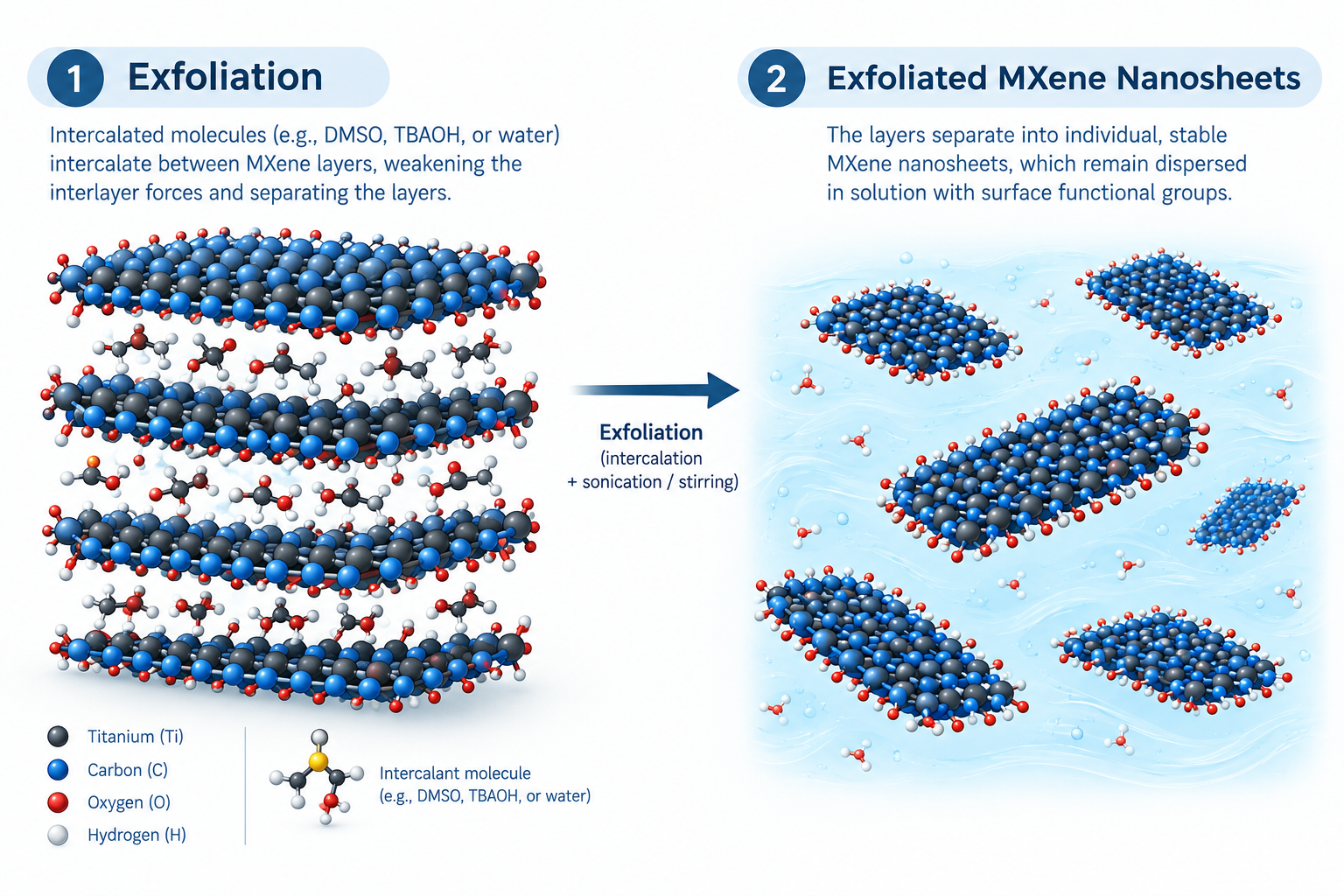
MXenes are typically produced by selectively removing a layer from a precursor material known as a MAX phase. For example, etching aluminum from Ti3AlC2 produces multilayer Ti3C2Tx. The resulting material consists of stacked layers of transition metal carbides, nitrides, or carbonitrides.
After synthesis, these layers often remain aggregated or stacked together. Exfoliation separates these layers into thinner sheets, while delamination typically refers to producing single-layer or few-layer nanosheets. Delamination has traditionally relied on chemical intercalation, in which ions or molecules such as lithium (from LiCl or LiF/HCl etching), TMAOH, or DMSO are inserted between the layers to weaken interlayer bonding before shaking or sonication.
The goal is to maximize the material's accessible surface area while preserving its structure and desirable properties.
Researchers generally seek exfoliation methods that can:
- Produce thin, high-quality nanosheets
- Minimize structural damage
- Reduce contamination
- Improve processing efficiency
- Enable scalable production
- Create stable dispersions for downstream applications
Meeting all these objectives simultaneously remains a key challenge in MXene manufacturing.
Why Exfoliation Matters
As with other layered materials such as graphene, many of MXene's most valuable properties become more accessible when the material is separated into thinner layers.
Effective exfoliation can help:
- Increase specific surface area
- Improve dispersion stability
- Enhance electrical performance
- Improve interaction with polymers and composites
- Enable coating, printing, and film-forming applications
- Improve accessibility of active sites in electrochemical systems
Poor exfoliation, by contrast, can leave large agglomerates that limit performance and make subsequent processing more difficult.
Common MXene Exfoliation Methods
Several techniques are currently used in laboratories and pilot-scale research. Each method relies on a different mechanism to separate layered structures.
Sonication
Sonication is among the most widely used MXene exfoliation techniques and is often paired with chemical intercalation to delaminate Ti3C2Tx into single- or few-layer flakes. The process uses high-frequency ultrasonic energy to generate cavitation within a liquid suspension.
As microscopic bubbles form and collapse, localized forces help separate stacked MXene layers.
Advantages
- Widely available equipment
- Well-established laboratory process
- Effective for small-scale research
- Relatively straightforward operation
LIMITATIONS
- Difficult to scale for high-volume production
- Processing times may become lengthy
- Energy efficiency can be a concern
- Batch-to-batch consistency can vary
For these reasons, sonication often serves as a valuable research tool but may present challenges when transitioning to larger-scale manufacturing.
Mechanical Shear Mixing
High-shear mixers use mechanical forces to generate shear stress within a suspension. As the material experiences these forces, layers can gradually separate and disperse.
Advantages
- Comparatively simple equipment
- Potential for larger batch sizes
- Lower equipment cost than some alternatives
LIMITATIONS
- May require extended processing times
- Exfoliation efficiency can vary
- Material loading limitations may apply
- Results are highly dependent on process conditions
Mechanical shear approaches can be useful for preliminary research and certain scale-up investigations.
Ball Milling
Ball milling utilizes grinding media to transfer mechanical energy into the material, breaking down particle structures through impact and friction.
Advantages
- Established industrial technology
- Capable of processing larger quantities
- Suitable for some powder-processing applications
LIMITATIONS
- Potential contamination from grinding media
- Risk of structural damage
- Broad particle size distributions
- Less control over exfoliation mechanisms
- May require extended processing times
For applications where purity and preservation of nanosheet structure are critical, researchers often evaluate alternative approaches.
High-Pressure Homogenization
High-pressure homogenization forces a suspension through a narrow flow path at high pressure, generating intense shear, turbulence, and impact forces.
Researchers have widely investigated this technique across numerous nanomaterial and dispersion applications because it offers continuous processing and can scale from laboratory to production environments.
Advantages
- Scalable processing approach
- Continuous operation potential
- Strong dispersive forces
- Reduced reliance on grinding media
- Potentially shorter processing times compared to some batch methods
LIMITATIONS
- Process parameters require optimization
- Results vary according to material systems
- Specialized equipment is required
- More frequent parts replacement
- Increased maintenance requirements
Researchers continue to investigate high-pressure fluid processing methods for a variety of advanced materials where efficient size reduction and exfoliation are desired.
Wet Jet Milling
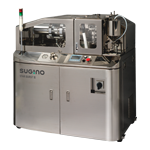
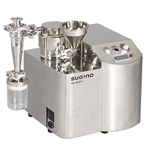
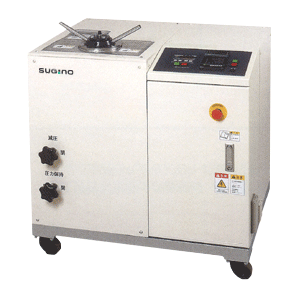
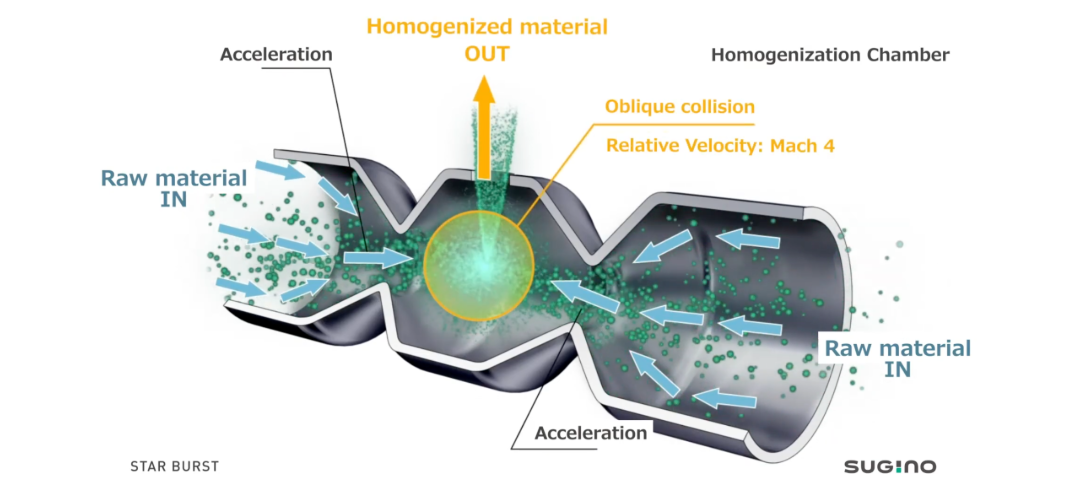
Wet jet milling uses high-pressure fluid forces to process suspensions and dispersions. It accelerates material through specialized chambers where shear forces, cavitation, and particle interactions promote exfoliation and delamination. Unlike mechanical milling methods, wet jet milling does not rely on grinding media.
Advantages
- Media-free processing minimizes contamination risk.
- Combines shear, cavitation, and impact forces for exfoliation and delamination.
- May eliminate the need for chemical intercalation and associated purification steps. Recent research demonstrated MXene delamination without chemical intercalants.
- Can reduce process time and increase yield compared to some conventional chemical delamination methods.
- Offers flexibility through adjustable processing parameters such as pressure, chamber design, and number of passes.
- Can help disperse agglomerated particles while preserving particle morphology because no grinding media are used.
- Handles high-solid-loading, high-viscosity MXene dispersions.
- Engineered with wear-resistant components for longer operating life.
- Allows users to easily clear clogs and perform routine maintenance.
As interest in scalable MXene manufacturing grows, fluid-based technologies such as high-pressure homogenization and wet jet milling are attracting increasing attention. Recent research suggests these approaches may offer a path toward higher-throughput production while reducing the need for chemical intercalants, minimizing waste streams, and maintaining material quality comparable to conventionally delaminated MXenes.
LIMITATIONS
- Specialized equipment is required.
- Process parameters must be optimized for each material system.
- Research on MXene-specific processing remains limited compared to established methods such as sonication.
- Multiple passes may be required depending on the desired morphology.
SAMPLE TESTING AVAILABLE
Curious if wet jet milling with Star Burst™ is a fit for your application? Talk to an application engineer or request sample testing to learn more.
Request Sample Testing
Selecting the Right MXene Processing Method
No single exfoliation method is ideal for every application.
Researchers typically balance various factors such as:
| Method | Scalability | Contamination Risk | Flake Damage Risk |
|---|---|---|---|
| Sonication | Low | Low (probe tip wear) | Medium (flake fragmentation) |
| Mechanical shear mixing | Medium | Low | Low–Medium |
| Ball milling | High | High (grinding media) | High |
| High-pressure homogenization | High | Low | Low–Medium |
| Wet jet milling (Star Burst™) | High | Low (media-free) | Low |
The optimal solution often depends on whether the objective is fundamental research, pilot-scale development, or commercial production.
The Future of MXene Processing
As interest in MXenes grows, attention is shifting from laboratory-scale research to scalable, repeatable manufacturing processes.
Researchers are actively evaluating technologies that can:
- Improve exfoliation efficiency
- Reduce processing costs
- Minimize contamination
- Increase throughput
- Maintain consistent product quality
- Preserve the structure and morphology of carefully synthesized materials
While effective exfoliation remains a primary objective, it is only one part of the broader manufacturing challenge. In many advanced material applications, particles can agglomerate during synthesis or later processing steps. Separating these agglomerates without damaging the underlying nanosheets is often just as important as achieving exfoliation itself.
This consideration has led researchers to explore a variety of fluid-based processing technologies, including high-pressure homogenization and wet jet milling. Compared with media-based milling methods, these approaches may offer advantages in applications where minimizing contamination and preserving particle integrity are critical.
No single exfoliation method has emerged as the definitive solution for every MXene application. The optimal approach depends on factors such as desired layer thickness, material quality requirements, production scale, processing efficiency, and sensitivity to particle damage.
As MXene commercialization advances, the most successful processing technologies will likely balance scalability and efficiency with careful control of material structure. Achieving high-quality dispersions while preserving the characteristics that make MXenes valuable may ultimately prove as important as the exfoliation process itself.
FAQs
What is MXene exfoliation?
MXene exfoliation is the process of separating stacked MXene layers into thinner sheets, often to improve surface area, dispersion stability, and application performance.
What is the difference between exfoliation and delamination?
Exfoliation generally refers to separating layered structures, while delamination often describes producing single-layer or few-layer nanosheets from those structures.
Why is MXene exfoliation important?
Many of MXene's desirable properties become more accessible when the material is separated into thinner layers, increasing surface area and improving interaction with surrounding materials.
What is the most common MXene exfoliation method?
Chemical intercalation, usually followed by shaking or sonication, remains the most common laboratory method for delaminating MXenes such as Ti3C2Tx. Researchers continue to investigate alternative methods to improve scalability and efficiency.
Can high-pressure homogenization be used for MXene processing?
Researchers are investigating high-pressure fluid-processing techniques, including homogenization methods, as potential approaches for exfoliating and dispersing layered nanomaterials. Results depend on the material system and process conditions.
How does Star Burst™ sample testing work?
Send us a sample of your multilayer MXene or other material, along with your solvent, solids loading, and target flake size. Our application engineers run it on Star Burst in our Chicago-area lab, adjust pressure and the number of passes for your material, and return the processed sample with run data so you can characterize the results in your own lab. NDAs are available. Request sample testing →
SAMPLE TESTING AVAILABLE
Exfoliate MXene Without Grinding Media
Whether you're working at lab scale or planning for production, we can help you determine if wet jet milling fits your MXene process, then test it on your sample.
Talk to Us About Sample Testing